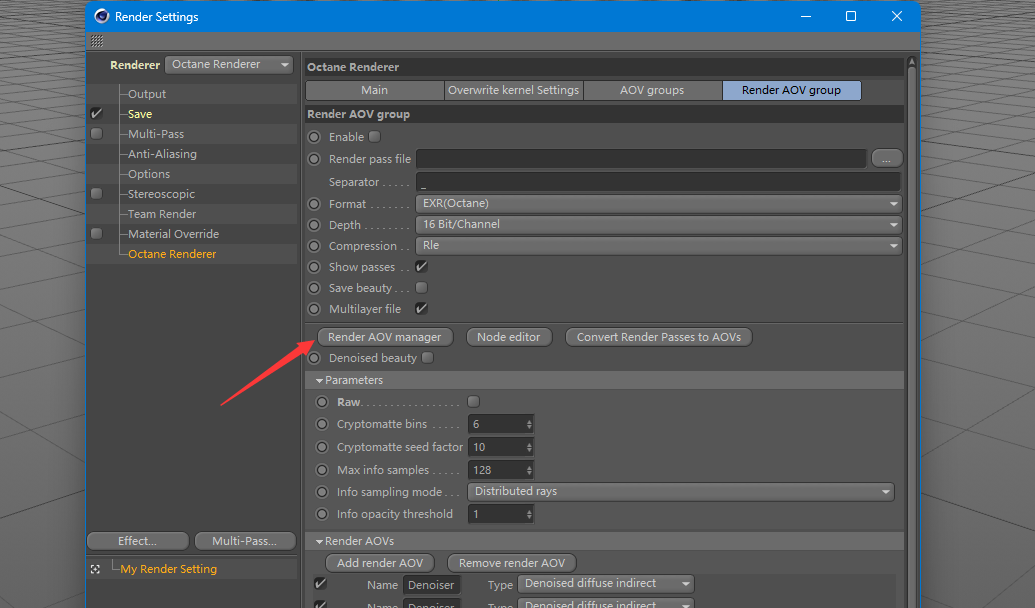
• How to get octane aov manager in python

    Moved General Talk python sdk
    7
    2
    0 Votes
    7 Posts
    2k Views
    ferdinandF
    Hello @render_exe, Thank you for reaching out to us. Unfortunately, as already pointed out by @Dunhou, questions about third party APIs are out of scope of support: Forum Guidelines: Scope of Support We cannot provide support on learning either C++, Python or one of its popular third party libraries. Thank you @Dunhou for providing such a nice community answer. Since this topic is not about the Cinema 4D SDK, I have moved it to General Talk. Cheers, Ferdinand
  • 0 Votes
    5 Posts
    2k Views
    ymoonY
    @ferdinand It Works. Thank You
  • CUSTOMGUI_QUICKTAB trigger twice when click

    Cinema 4D SDK sdk python 2023 windows
    7
    0 Votes
    7 Posts
    804 Views
    ferdinandF
    hey @Gene, So, you were just trying to add information for future readers? That is of course very welcome and explains my inability to extract a question from your posting. I would not have been that generous with the word bug either. Since this has never been fixed, chances are high that we came to the same conclusion internally. In general, you should not expect Command calling patterns to make perfect sense in every case. There are multiple cases where Command is triggered more often than one would think at first glance. I would also not try to interpret some deeper sense into all that. Cheers, Ferdinand
  • 0 Votes
    3 Posts
    504 Views
    chuanzhenC
    @i_mazlov Thanks
  • Instance Object Link is not working

    Cinema 4D SDK python
    3
    1
    0 Votes
    3 Posts
    933 Views
    M
    Hello @aghiad322, without further questions or postings, we will consider this topic as solved by Monday 05/06/2023 and flag it accordingly. Thank you for your understanding, Maxime.
  • 0 Votes
    3 Posts
    795 Views
    B
    @i_mazlov Gotcha. Thanks. Works as expected.
  • Inserting items into dropbox to TreeView

    Cinema 4D SDK
    4
    1
    0 Votes
    4 Posts
    892 Views
    M
    Hi @simonator420 for this purpose you have to define GetDropDownMenu and SetDropDownMenu. GetDropDownMenu is called by Cinema 4D to retrieve the content of the menu to display from the menuInfo dictionary. For more information about this dictionary please have a look at TreeViewDropDownMenuInfo Dict. SetDropDownMenu is called by Cinema 4D when the user select a value from the dropdown. Find bellow an implementation example: def GetDropDownMenu(self, root, userdata, obj: Entry, lColumn, menuInfo): menuInfo["entry"] = 1001 # Select teh second entry menuInfo["menu"][1000] = "First Entry" menuInfo["menu"][1001] = "Second Entry" menuInfo["menu"][1002] = "ThirdEntry" menuInfo["state"] = int(menuInfo["state"]) # Workaround to not have warning in Cinema 4D. Will be fixed in the next C4D version. def SetDropDownMenu(self, root, userdata, obj, lColumn, entry): print(f"User selected the entry with the ID: {entry}") Finally note that due to an issue that will be fixed in the upcoming version of Cinema 4D, even if you do not change the state, you need to override it to an int value otherwise it will print an error in the console (this is not blocking but still). Cheers, Maxime.
  • 0 Votes
    4 Posts
    1k Views
    ferdinandF
    Hello @Gene, So far it's doing exactly what I need. Only issue I have is if I need to undo the script. I have to press the Undo button several times because C4D creates an undo state for every Tag/Object selection step in the script, instead of putting all of them under one undo state. I think this is a long-existing limitation of C4D's Undo system? Well, it depends a bit on what you would consider a "long-existing limitation", but you can consolidate multiple operations into a singular item in the undo-stack. The most relevant methods are BaseDocument.StartUndo, BaseDocument.EndUndo, and BaseDocument.AddUndo (there more undo related methods on BaseDocument). Cheers, Ferdinand """Demonstrates wrapping selecting all top-level objects in a document into one undo item. """ import c4d doc: c4d.documents.BaseDocument def main(): """ """ obj: c4d.BaseObject = doc.GetFirstObject() # Start an undo item in the undo stack. doc.StartUndo() while obj: # Add an operation to the undo item, most operations must be invoked BEFORE the actual # operation is carried out. The only exception is inserting new nodes, AddUndo must here # be called AFTER the operation. doc.AddUndo(c4d.UNDOTYPE_ACTIVATE, obj) doc.SetActiveObject( obj, c4d.SELECTION_NEW if obj == doc.GetFirstObject() else c4d.SELECTION_ADD) obj = obj.GetNext() # Close the item. doc.EndUndo() c4d.EventAdd() if __name__ == "__main__": main()
  • C4D octane materials to redshift.

    Cinema 4D SDK python project tool
    4
    0 Votes
    4 Posts
    3k Views
    S
    Unfortunately this script doesn't include Specular and Displacement channels conversion.
  • 0 Votes
    2 Posts
    210 Views
    ferdinandF
    Hello @chuanzhen, Thank you for reaching out to us. Thank you for pointing this out, half of the word "offline" was pointing towards the offline C++ documentation. I have updated the link. Cheers, Ferdinand
  • Python Generator use a script

    Cinema 4D SDK python 2023
    3
    0 Votes
    3 Posts
    557 Views
    K
    Thanks
  • 0 Votes
    3 Posts
    632 Views
    J
    Hi @ferdinand , First of all, I apologize for my poor explanation. I ran into an unexplainable situation, but your example solved my problem nicely. I couldn't get consecutive characters because I mistakenly called the self.GetInputState(c4d.BFM_INPUT_MOUSE, msg.GetInt32(c4d.BFM_INPUT_CHANNEL), msg) method and it would interrupt getting the original input. now I have solved the problem. Thank you very much you guys are the best! Cheers~
  • Get Points and Polygons from Primitives

    Cinema 4D SDK 2023 python c++
    2
    0 Votes
    2 Posts
    609 Views
    M
    Hi @CJtheTiger primitives are generators that generate and holds a PolyonObject in there cache. So most of the time for simple primitive like a cube, to access its generated PolygonObject, you should first retrieve it's cache with the GetCache method. If you want a more indepth introduction to this topic please read SDK Example - Geometry Readme. Then if you want to cover more complex cases I suggest you to read geometry_caches Example. And if you want to visualize the cache and the scene structure I would highly recommend to take a look at the C++ Example - activeobject dialog. Finally regarding the spline creation, you can find all the information needed to create a spline in Python Example - SplineObject, if you have more question on the spline creation please open a new topic. Cheers, Maxime.
  • 0 Votes
    4 Posts
    1k Views
    ferdinandF
    Hello @derekheisler, Welcome to the Plugin Café forum and the Cinema 4D development community, it is great to have you with us! Getting Started Before creating your next postings, we would recommend making yourself accustomed with our Forum and Support Guidelines, as they line out details about the Maxon SDK Group support procedures. Of special importance are: Support Procedures: Scope of Support: Lines out the things we will do and what we will not do. Support Procedures: Confidential Data: Most questions should be accompanied by code but code cannot always be shared publicly. This section explains how to share code confidentially with Maxon. Forum Structure and Features: Lines out how the forum works. Structure of a Question: Lines out how to ask a good technical question. It is not mandatory to follow this exactly, but you follow the idea of keeping things short and mentioning your primary question in a clear manner. About your First Question Please excuse the slight delay and thank you for the community answer provided by @HerrMay. The core misconception in your code lies in the line objs = doc.GetObjects(), as it does not get a list of all objects in doc, but only the root level objects. Users are expected to do scene graph traversal on their own at the moment, there is no method which would do it for you. There are also other problems with your code, as for example trying to instantiate a BaseThread or using CallCommand (not a real problem but not recommended in most cases). There have been also multiple similar threads in the past: How do you collapse complex dependencies in order?: This is about implementing a connect and delete. How to traverse a GeListNode Tree?: This is about hierarchical traversal, i.e., getting all descendants and siblings for a node. There is also something that I would call branch traversal, it is much more complex and we have talked about it for example here. CAD Normal Tag flipped: Entirely different topic, but could give you an idea on how to realize a simple GUI for this. Finde below a simple example. Cheers, Ferdinand Result: [image: 1680193792635-collapse.gif] Code: """Demonstrates how to collapse all SDS objects in a scene. One could also make this more fancy with a GUI and undo steps, I did not do this here. """ import c4d doc: c4d.documents.BaseDocument # The active document. def IterNodes(node: c4d.GeListNode) -> c4d.GeListNode: """Yields all descendants and next-siblings of `node` in a semi-iterative fashion. """ if node is None: return while node: yield node # The recursion moving down. for descendant in IterNodes(node.GetDown()): yield descendant # The iteration in one level. node = node.GetNext() def Collapse(objects: list[c4d.BaseObject]) -> None: """Collapses all items in #objects as individual root nodes into singular objects. This function mimics the behaviour of the builtin (but unexposed) "Connect & Delete" command by first running the "CSTO" and then "JOIN" command. With setups complex enough, this can still fail due to the non-existent dependency graph of the classic API (when one does CSTO things in the wrong order). In 99.9% of the cases this will not be the case, but one should get the inputs with #GETACTIVEOBJECTFLAGS_SELECTIONORDER as I did below to give the user more control. (or alternatively do not batch operate). """ if len(objects) < 1: raise RuntimeError() doc: c4d.documents.BaseDocument = objects[0].GetDocument() doc.StartUndo() # CSTO all local hierarchies in #objects and replace these root nodes with their collapsed # counter parts. result = c4d.utils.SendModelingCommand(c4d.MCOMMAND_CURRENTSTATETOOBJECT, objects, c4d.MODELINGCOMMANDMODE_ALL, c4d.BaseContainer(), doc, c4d.MODELINGCOMMANDFLAGS_NONE) if not result or len(result) != len(objects): raise RuntimeError() for old, new in zip(objects, result): parent, pred = old.GetUp(), old.GetPred() doc.AddUndo(c4d.UNDOTYPE_DELETEOBJ, old) old.Remove() doc.InsertObject(new, parent, pred) doc.AddUndo(c4d.UNDOTYPE_NEWOBJ, new) # Join the CSTO results root by root object, and then replace the CSTO results with the final # collapsed result. JOIN is a bit weird when it comes to transforms, so we must store the # transform of the to be joined object, then zero it out, and finally apply it to the joined # result again. for obj in result: mg: c4d.Matrix = obj.GetMg() obj.SetMg(c4d.Matrix()) joined = c4d.utils.SendModelingCommand(c4d.MCOMMAND_JOIN, [obj], c4d.MODELINGCOMMANDMODE_ALL, c4d.BaseContainer(), doc, c4d.MODELINGCOMMANDFLAGS_NONE) if not joined: raise RuntimeError() parent, pred = obj.GetUp(), obj.GetPred() doc.AddUndo(c4d.UNDOTYPE_DELETEOBJ, obj) obj.Remove() new: c4d.BaseObject = joined[0] new.SetMg(mg) doc.InsertObject(new, parent, pred) doc.AddUndo(c4d.UNDOTYPE_NEWOBJ, new) doc.EndUndo() c4d.EventAdd() def main() -> None: """Runs the example. """ # Find all SDS objects in the scene. objectList: list[c4d.BaseObject] = [ n for n in IterNodes(doc.GetFirstObject()) if n.CheckType(c4d.Osds)] # Collapse all SDS objects we have found. for obj in objectList: # We have to check if #obj is still a valid reference because we could have already # collapsed the object away in a prior iteration; sds-objects can live inside sds-objects. if not obj.IsAlive(): continue # Collapse the object. Collapse([obj]) c4d.EventAdd() if __name__ == "__main__": main()
  • How to dynamically hide parameters

    Cinema 4D SDK python 2023
    2
    1
    0 Votes
    2 Posts
    688 Views
    ferdinandF
    Hello @kng_ito, Thank you for reaching out to us. Modifying the description of a node via NodeData.GetDDescription should only be done when NodeData.GetDEnabling is not sufficient. To hide a parameter, the field c4d.DESC_HIDE must be set to True. Find a simple example below. Cheers, Ferdinand Result: [image: 1680101928166-hide_param.gif] File: pc14487.zip Code: // The description defintion of the tag Texample. CONTAINER Texample { NAME Texample; INCLUDE Texpression; // The main "Tag" tab of the tag. GROUP ID_TAGPROPERTIES { // The element which is being hidden (or not). REAL ID_HIDDEN_ELEMENT { MIN 0.0; MAX 100.0; UNIT METER; STEP 0.001; CUSTOMGUI REALSLIDER; } // The parameter based on which the hidden element is shown or not. BOOL ID_HIDE_CONDITION {} } } """Implements a tag which dynamically hides and shows a parameter. """ import c4d import typing class ExampleTagData(c4d.plugins.TagData): """Implements a tag which dynamically hides and shows a parameter. """ # The plugin ID for the hook. ID_PLUGIN: int = 1060794 @classmethod def Register(cls) -> None: """Registers the plugin hook. """ if not c4d.plugins.RegisterTagPlugin( id=cls.ID_PLUGIN, str="Example Tag", info=c4d.TAG_EXPRESSION | c4d.TAG_VISIBLE, g=cls, description="texample", icon=c4d.bitmaps.InitResourceBitmap(c4d.Tdisplay)): print(f"Warning: Failed to register '{cls}' tag plugin.") def Init(self, node: c4d.GeListNode) -> bool: """Called to initialize a tag instance. Args: node: The BaseTag instance representing this plugin object. """ self.InitAttr(node, float, c4d.ID_HIDDEN_ELEMENT) self.InitAttr(node, bool, c4d.ID_HIDE_CONDITION) node[c4d.ID_HIDDEN_ELEMENT] = 50.0 node[c4d.ID_HIDE_CONDITION] = False return True def Execute(self, tag: c4d.BaseTag, doc: c4d.documents.BaseDocument, op: c4d.BaseObject, bt: c4d.threading.BaseThread, priority: int, flags: int) -> int: """Called when expressions are evaluated to let a tag modify a scene. Not used in this case. """ return c4d.EXECUTIONRESULT_OK def GetDDescription(self, node: c4d.GeListNode, description: c4d.Description, flags: int) -> typing.Union[bool, tuple[bool, int]]: """Called by Cinema 4D when the description of a node is being evaluated to let the node dynamically modify its own description. """ # Bail when the description cannot be not fully loaded. if not description.LoadDescription(node.GetType()): return False, flags # Define the ID of the parameter we want to modify and get the ID of the parameter which is # currently to be evaluated. paramId: c4d.DescID = c4d.DescID(c4d.DescLevel(c4d.ID_HIDDEN_ELEMENT, c4d.DTYPE_REAL, 0)) evalId: c4d.DescID = description.GetSingleDescID() # Bail when there is a to be evaluated parameter and our parameter is not part of or equal # to the evaluated parameter. if (evalId and not paramId.IsPartOf(evalId)): return True, flags # Get the description data container instance (GetParameter>I<) for the parameter we want to # modify. All changes made to the container will be directly reflected on the node. paramData: c4d.BaseContainer = description.GetParameterI(paramId) if paramData is None: return True, flags # Set the hidden state of the parameter ID_HIDDEN_ELEMENT based on the value of the # parameter ID_HIDE_CONDITION. paramData[c4d.DESC_HIDE] = node[c4d.ID_HIDE_CONDITION] return True, flags | c4d.DESCFLAGS_DESC_LOADED if __name__ == "__main__": ExampleTagData.Register()
  • 0 Votes
    4 Posts
    912 Views
    ferdinandF
    Hello @HerrMay, Is the multiplication of a matrix with a vector (mg.off = mg * p) essentially the same what mg * c4d.utils.MatrixMove(vec) does? No, mg * p multiplies a matrix by a vector which will yield the transformed vector p'. mg * c4d.utils.MatrixMove(vec) on the other hand multiplies two matrices, yielding the combined transform of them, a new matrix. What would be equivalent to mg * p is mg * c4d.utils.MatrixMove(p) * c4d.Vetcor(0, 0, 0). Please note that the whole subject is also out of scope of support as declared in the forum guidelines. I understand that the subject is a common barrier for the more on the artist-sided leaning users of ours, and I help where I can, but we cannot teach you vector math, linear algebra, or however you want to label this subject. Find below a short code example. Cheers, Ferdinand Output: M = Matrix(v1: (1, 0, 0); v2: (0, 1, 0); v3: (0, 0, 1); off: (0, 100, 0)) p = Vector(100, 0, 0) M * p = Vector(100, 100, 0) M * c4d.utils.MatrixMove(c4d.Vector(100, 0, 0)) = Matrix(v1: (1, 0, 0); v2: (0, 1, 0); v3: (0, 0, 1); off: (100, 100, 0)) M * c4d.Vector(100, 0, 0) = Vector(100, 100, 0) N * c4d.Vector( 0, 0, 0) = Vector(100, 100, 0) M * c4d.utils.MatrixMove(p) * c4d.Vector(0, 0, 0) = Vector(100, 100, 0) Code: import c4d # Let us assume #M to be the global matrix/transform of some object #op. View it as a tool to # transform a point in global space into the local coordinate system of #op. M: c4d.Matrix = c4d.Matrix(off=c4d.Vector(0, 100, 0)) # The matrix #M now has this form: # # | v1 1 0 0 | # The "x-axis" of the coordinate system defined by #M. # | v2 0 1 0 | # The "y-axis" of the coordinate system defined by #M. # | v3 0 0 1 | # The "z-axis" of the coordinate system defined by #M. # ---------------------- # | off 0 100 0 | # The origin of the coordinate system defined by #M. # # I.e., #M has the standard orientation and scale and only translates all things by 100 units # on the y-axis. So, the object #op would have the Euler angles (0°, 0°, 0°), the scale (1, 1, 1) # and the position (0, 100, 0) in world coordinates. # Define a vector #p to transform and print both #M and #p. p: c4d.Vector = c4d.Vector(100, 0, 0) print(f"{M = }") print(f"{p = }") # Transforming a point #p by a matrix #M will yield a point #q that is in the same relation to #M # as #p is to the global frame. q: c4d.Vector = M * p # #q will be the vector (100, 100, 0) because , (100, 100, 0) and #M are the same relation as #p # and the identity matrix are, a.k.a., the world frame. In a less technical way, (0, 100, 0) is the # origin of the coordinate system defined by #M. And to express #p in a manner as if #M would be # its coordinate system, we have to add (0, 100, 0), because that is the new origin. For orientation # and scale it works more or less the same, I would recommend having a look at the Matrix manual or # Wikipedia article on the subject. print (f"{M * p = }") # We can construct new transforms in many ways (again, Matrix Manual :)), one of them is by # combining multiple transforms via matrix multiplication. # We "add" the translation transform (100, 0, 0) to #M. Note that matrix multiplication is not # commutative, i.e., "M * N = N * M" does not always hold true. In this case it would because only # translations are involved. N: c4d.Matrix = M * c4d.utils.MatrixMove(c4d.Vector(100, 0, 0)) print(f"{M * c4d.utils.MatrixMove(c4d.Vector(100, 0, 0)) = }") # To get the same point as #q when multiplying a point #r with #N, we must pick the null-vector # because the origin of #N is already at where M * (100, 0, 0) is. print (f"{M * c4d.Vector(100, 0, 0) = }") print (f"{N * c4d.Vector( 0, 0, 0) = }") # We can also do it in one operation: print (f"{M * c4d.utils.MatrixMove(p) * c4d.Vector(0, 0, 0) = }")
  • 0 Votes
    4 Posts
    825 Views
    M
    Hello @HerrMay, without further questions or postings, we will consider this topic as solved by Monday 05/06/2023 and flag it accordingly. Thank you for your understanding, Maxime.
  • 0 Votes
    3 Posts
    533 Views
    H
    Hi @m_adam, alrighty, good to know that this will be looked into and eventually get fixed. Yes, I remember I returned True in the past. In the python tag as well as in the TagData equivalent. As returning super didn't work. Thanks for the information anyway. Cheers, Sebastian
  • 0 Votes
    3 Posts
    911 Views
    B
    Hi Manuel, Thank you very much. Your script works perfectly in my environment. Only one modification I made was if "color" in portPath: to if "color" in str(portPath): Thank you.
  • Python Tag how to hide a mogragh object

    Cinema 4D SDK python windows 2023
    7
    0 Votes
    7 Posts
    1k Views
    DunhouD
    @Manuel Oh, what a pitty! I know that I can dot it with a effector, but it is not a "all in one" solution for my convenient,but that's it , I will not spend times in it. Thanks for your research, and @HerrMay thanks for your enthusiastic answers ! Cheers~ DunHou